Your Brain's Alarm System: What Happens to Your Brain in a Traumatic Event

So far on the blog, we’ve talked about our “brilliant adaptations” and the “Four Fs” (Fight, Flight, Freeze, and Fawn) that our bodies use to survive.
But why does this happen? Why do we get “hijacked” by these responses, even when we “know” we’re safe?
It’s not a choice. It’s not a weakness of character. It is pure, high-speed biology. To understand it, we need to take a quick tour of your brain’s internal security team.
Think of your brain as a complex building with a highly advanced security system. There are three key players on duty 24/7.
Meet the Key Players
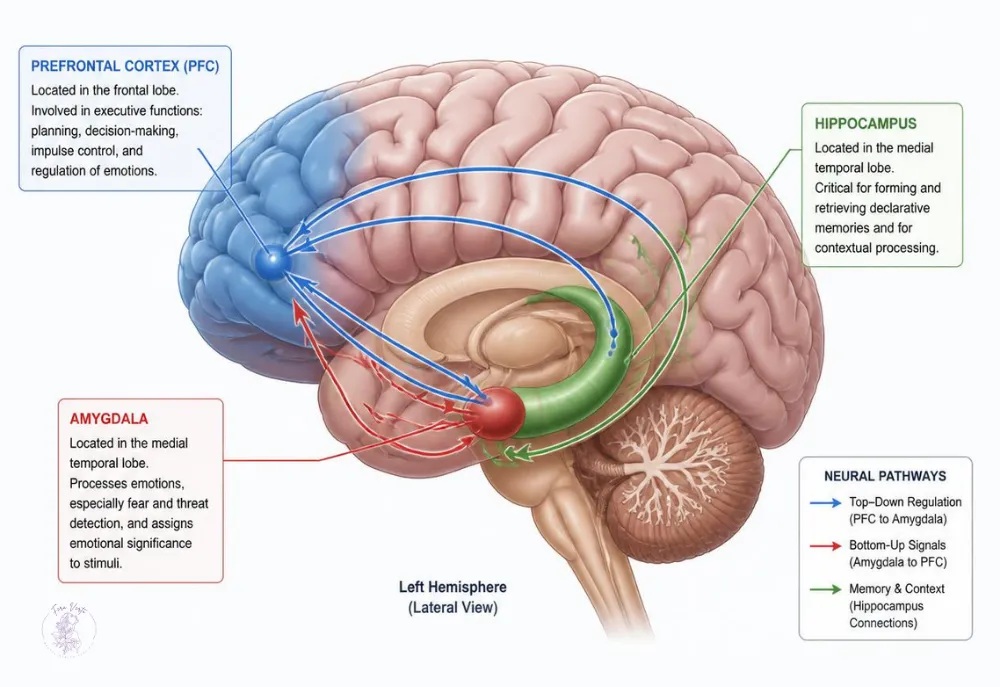
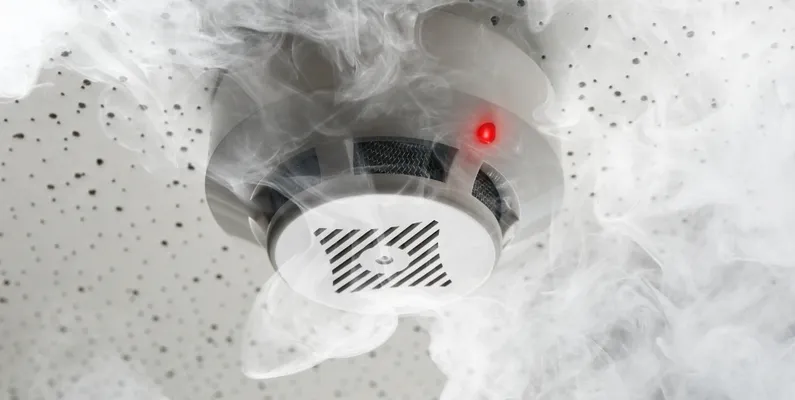
1. The Amygdala (The Smoke Detector) 🔥 Deep in your brain, you have a small, almond-shaped set of neurons. This is your amygdala. Its one and only job is to ask, “Am I safe?” It’s the building’s hypersensitive smoke detector. It doesn’t analyze—it just reacts. It’s designed to be fast, not smart.
2. The Prefrontal Cortex (The Watchtower) 🔭 This is the part of your brain right behind your forehead. It’s the building’s sophisticated watchtower and security office. It’s your “thinking brain.” It analyzes data, makes logical decisions, manages impulses, and can tell the difference between a real fire and someone just burning toast.
3. The Hippocampus (The Librarian) 📚 Nearby the amygdala is your hippocampus. This is the building’s meticulous librarian. Its job is to take your experiences, index them, and file them away as memories. It answers questions like “When did this happen?” “Where did this happen?” and “What else was happening at the time?” It creates the “story” of your life.
The Anatomy of a Hijack
On a normal, safe day, these three parts work together beautifully.
- Information comes in (you see a car, you hear a song).
- It goes to the Prefrontal Cortex (Watchtower), which calmly analyzes it: “That’s just a car driving by. We are safe.”
- The Hippocampus (Librarian) files it away: “File this under ‘Tuesday, 10:30 AM, sitting at my desk.’”
- The Amygdala (Smoke Detector) stays quiet. All is well.
But when your brain perceives a major threat, everything changes.
Let’s say you’re in a car accident. The system gets flipped upside down.
- The Alarm Triggers (AMYGDALA): The sound of screeching tires and the sight of oncoming headlights hit your senses. This sensory data takes a “low road,” a neural shortcut that goes straight to the Amygdala, bypassing the thinking brain entirely.
- The “Smoke Detector” pulls the alarm. It doesn’t wait for the Watchtower to confirm the fire. It screams, “DANGER! DANGER! DANGER!”
- The Command Center Activates: The Amygdala sends a distress signal to your Hypothalamus (the body’s command center). This center flips the switch on your HPA (Hypothalamic-Pituitary-Adrenal) axis.
- The Body Floods with Hormones: Your adrenal glands are ordered to pump out adrenaline (for immediate energy) and cortisol (the master stress hormone). This is the fuel for your 4 Fs. Your heart pounds, your breathing is shallow, your muscles tense, and your digestion stops. Your body is now 100% in survival mode.
The Thinking Brain Goes Offline
Here is the most important part of all:
In this moment, to save your life, your brain makes an executive decision. It shuts down all non-essential functions.
And what’s the least essential function when you’re about to be hit by a car? Slow, logical thought.
The flood of stress hormones effectively takes your Prefrontal Cortex (The Watchtower) offline. Your “thinking brain” is muted so your “survival brain” can take over. You don’t have time to think your way out of danger; you only have time to react.
This is the “amygdala hijack.”
At the same time, the Hippocampus (The Librarian) is also flooded with toxic levels of cortisol. It gets overwhelmed and can’t do its job properly. It can’t build a neat, linear story. It can’t put a time-stamp on the memory.
The Aftermath: Why Trauma Lingers
This brilliant survival process is what leaves us with the after-effects of trauma.
Because the Hippocampus couldn’t file the memory correctly, it doesn’t get stored as a “story” that is over. Instead, it’s stored as fragmented, unprocessed pieces:
- A mental image of headlights.
- The sound of screeching tires.
- The feeling of your heart in your throat.
- The smell of burnt rubber.
These fragments are left rattling around the system, unfiled.
Meanwhile, the Amygdala (Smoke Detector) has learned its lesson: “The world is incredibly dangerous.” It becomes hyper-vigilant, turning its sensitivity dial way up.
Now, months or years later, you hear a car’s tires screech on a perfectly safe day. Your PFC (Watchtower) isn’t fast enough. The sound takes the “low road” shortcut straight to your over-sensitive Amygdala, which instantly pulls the fire alarm.
Your body floods with adrenaline and cortisol. Your heart pounds. You freeze. You are, in every physiological sense, back in the car accident.
Your “thinking brain” (PFC) eventually catches up and says, “Wait, we’re safe, we’re just on the sidewalk.” But it’s too late. The hijack has already happened.
This is a flashback. This is a trigger. It is not a memory; it’s a re-experiencing. It’s your brain’s brilliant, high-speed security system doing the job it learned to do… just a little too well.
Healing, then, is not about “getting over it.” It’s about retraining this system. It’s about helping the Watchtower come back online, calming the Smoke Detector, and finally helping the Librarian file those fragmented memories away as “over.”