Why Does My Stomach Know I'm Stressed Before I Do?

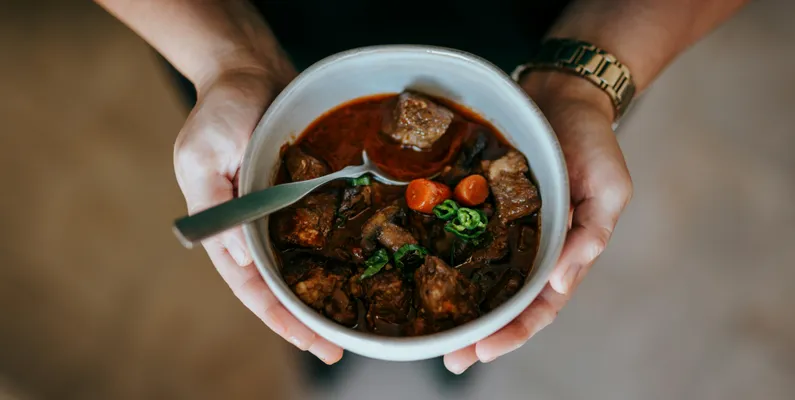
You organized the whole dinner. You picked the restaurant, booked a table for eight, worked out the seating so your mom and your sister aren’t side by side, and sent everyone the parking details. Twice.
Then the food arrives, and you can’t eat a single bite.
Your stomach is in knots. Or it’s doing that flip-floppy thing. Or you’ve already made two trips to the washroom and you’re wondering if anyone would notice a third. Meanwhile, your brain keeps insisting you’re fine. It’s just dinner. Everyone’s having a nice time.
If that sounds familiar, you’re in very good company. “My stomach always knows before I do” is one of the things I hear most often in my office. And I’ll let you in on something: your stomach is usually right.
Your gut has been on the job this whole time
Here’s the short version of a long and fascinating story. Your gut and your brain are constantly texting each other. The main line between them is the vagus nerve, which wanders all the way from your brainstem down through your chest and into your belly. Your stress hormones, your immune system and the trillions of bacteria living in your gut are all in the group chat too.
When your body senses danger, digestion is one of the first things it puts on hold. That makes sense. If you’re running from a bear, it’s not the moment to be breaking down a sandwich. Energy gets sent to your muscles, your heart speeds up, and your gut is told to wait.
Great plan for a bear. A lot less helpful when the “bear” is a full inbox, a tense phone call or a dinner you’ve been holding together single-handedly.
And if you grew up somewhere you had to stay on alert, or you’ve lived through things that taught your body the world isn’t safe, that switch can get stuck. I call these protective responses your bodyguards, and when the fight and flight bodyguards are in charge, one of the first things they do is close the kitchen. Some people’s kitchens have been closed for years. No wonder their stomachs are tired.
So what does the research say?
This is where my nursing brain gets excited, so bear with me. (Last bear reference. Probably.)
Researchers are paying a lot of attention to the gut and trauma, and some of what they’re finding lines up with what people have been telling me for years:
- Trauma and tummy trouble often travel together. A 2025 study of more than 1,400 university students found that the more kinds of trauma someone had been through, and the stronger their PTSD symptoms, the more gut symptoms they reported.
- Your gut bacteria may be part of the story. A 2026 review of 50 studies found that people with PTSD often have a less varied mix of gut bacteria, with fewer of the ones that help keep inflammation in check.
- The brake pedal gets harder to reach. Many people with PTSD have lower “vagal tone,” which basically means it’s harder for their body to calm itself down after stress. Researchers think this may help explain why poor sleep, jumpiness and gut problems so often show up together.
Now for the part the wellness headlines tend to skip. Most of these studies are small, and they show that things are connected, not what causes what. Does trauma change the gut? Does the gut change how we handle stress? Probably a bit of both, and nobody has it figured out yet. Even the link between a tough childhood and IBS is still up in the air. A large review of 15 studies found a connection for women, but the results were all over the map.
I’d rather tell you that than pretend I have all the answers.
About that probiotic you saw on Instagram
You may have seen someone promising that the right supplement will fix your anxiety. I wish it were that easy.
So far, probiotic trials for PTSD have been small and the results are mixed. One didn’t change people’s gut bacteria at all. The diet research isn’t much clearer, either. A 2025 review of five Mediterranean diet trials found no clear effect on depression.
So does food matter? Absolutely. It’s just not a cure. I think of it as part of the scaffolding. When you’re eating regularly and eating enough, your energy and blood sugar stay steadier, and you have more room to cope when life gets loud.
My nurse hat is going on for a second: if you have ongoing gut symptoms, blood in your stool, weight loss you can’t explain, or anything new, please get checked by your doctor or nurse practitioner. Same goes before you start a supplement. Sometimes a stomach problem is just a stomach problem, and it deserves proper care.
When eating was never just eating
For a lot of the women I work with, food comes with history.
Maybe dinnertime at your house was tense, and you learned to eat fast and get out. Maybe there wasn’t always enough. Maybe you were the one watching everyone else’s plate and everyone else’s mood, and your own hunger came last. Maybe it still does.
Skipping lunch because you’re “too busy,” living on coffee until 3 p.m., eating standing up at the counter, sticking to a short list of safe foods… none of this means you’re bad at taking care of yourself. These are habits you picked up to get through the hard days, and they made sense at the time. The more useful question is what they were protecting you from.
If food or your body feels complicated for you, go easy with this post. You don’t need another set of rules.
A few small things to try
No meal plans and no shopping lists. Just a few experiments:
- Eat at roughly the same times each day. Your nervous system loves predictability, and regular meals are one of the simplest “you’re safe” signals you can send it. Canada’s Food Guide is a flexible place to start, and a registered dietitian can help you make it fit your life.
- Take three slow breaths before the first bite. Make the exhale a little longer than the inhale. It sounds almost too simple, but it nudges your body back toward rest-and-digest. (I explain why in my Breathwork post.)
- Sit down to eat. Yes, you. Finishing someone else’s crusts over the sink is a snack, not a meal.
- Add something in instead of cutting things out. A new veggie, some beans, a bit of yogurt or kefir if it agrees with you. Your gut bacteria like variety.
Pick one and see what happens. No pressure if it’s not your thing.
Where therapy comes in
Here’s something I see again and again. When people start to understand why their body reacts the way it does, and work through what’s underneath it, their stomach often starts to settle too. It’s one of my favourite things to watch happen.
Because I’m a nurse as well as a psychotherapist, your gut isn’t a side issue for me. Your sleep, your digestion, your medications, your stress and your history all belong in the same conversation. Sometimes that means learning to notice your body’s early warning signs. Sometimes it means somatic work or working through old memories. Sometimes it means putting together a list of questions for your doctor. We figure out what fits you, together.
If your stomach has been carrying more than its share, I offer a free 30-minute consultation, in person in Ottawa or virtually across Ontario. Come as you are, knots and all.
Heal The Why Behind The What!
References & Further Reading
- Berendse, R., Verkleij, M., Daams, J., Hemmings, S., Lindauer, R., Korosi, A., Zantvoord, J. B., & Lok, A. (2026). The microbiome and PTSD: A scoping review across preclinical and clinical studies. European Journal of Psychotraumatology, 17(1). Link
- Marano, G., Lo Giudice, L., Specogna, E., Chisari, L., Brisi, C., Traversi, G., Mazza, O., & Mazza, M. (2026). From dysbiosis to distress: The gut–brain connection in trauma-related disorders. Nutrients, 18(3), 530. Link
- Bruce, et al. (2025). The relationship between trauma exposure, PTSD symptoms, and gastrointestinal symptoms. International Journal of Behavioral Medicine. Link
- Joshee, S., Lim, L., Wybrecht, A., Berriesford, R., & Riddle, M. (2022). Meta-analysis and systematic review of the association between adverse childhood events and irritable bowel syndrome. Journal of Investigative Medicine, 70(6), 1342–1351. Link
- Tavakoly, R., Moosburner, A., Anheyer, D., & Cramer, H. (2025). Effect of different dietary patterns on patients with depressive disorders: A systematic review and meta-analysis of randomized controlled trials. Nutrients, 17(3), 563. Link
- Health Canada. Canada’s Food Guide. Link